

Trending Oversight Topics
Governance Research
Governance Surveys
Directorship Magazine

Survey
NACD Quarterly Survey: Q2 2026 - Public Company
Boards’ AI Focus Centers on Cybersecurity
Public company boards’ focus on artificial intelligence (AI) has reached new levels, with the cybersecurity component taking center stage. This follows Anthropic’s announcement of its Claude Mythos model in April, which specializes in finding security flaws in software.
The Q2 2026 survey was in the field from June 16 to June 30 and asked directors to identify the top business issues on their boards’ agendas for Q3 2026. The survey captured responses from the 132 respondents serving on publicly traded company boards. (Quotes from survey respondents have been anonymized and appear in italics throughout.)
What are the top business issues on your board's agenda in the upcoming quarter?
(Public company respondents. Respondents could select up to five issues.)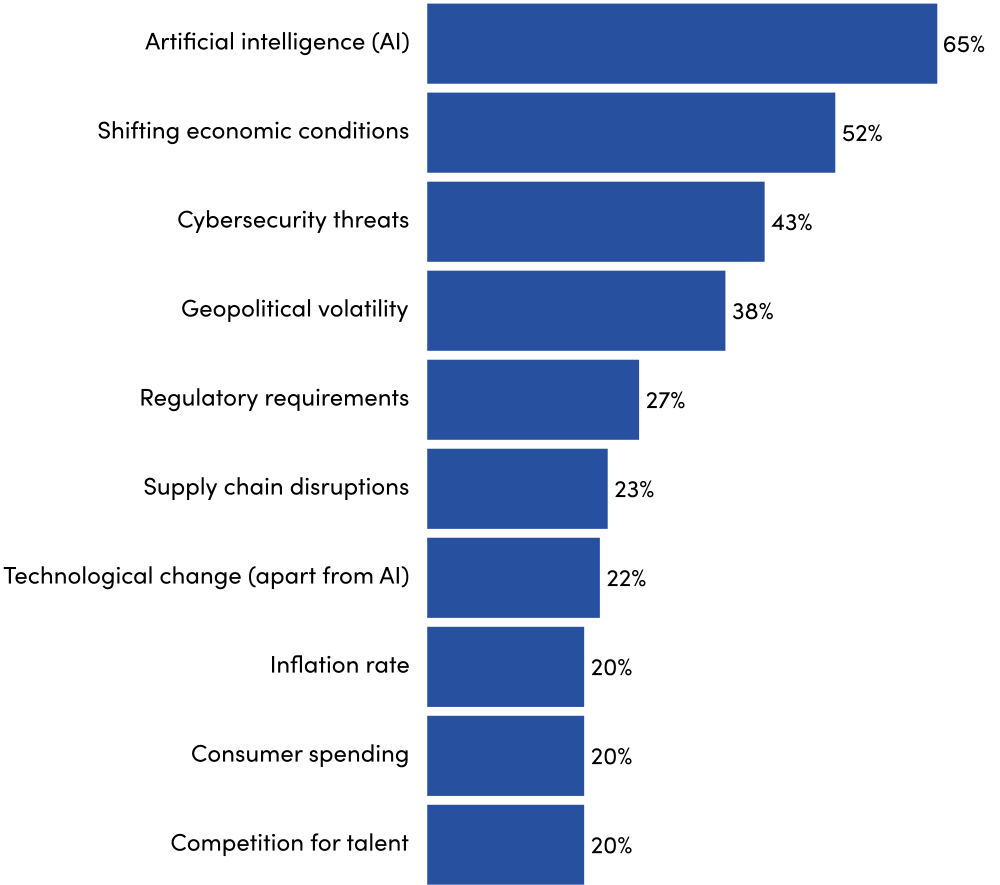
NACD Quarterly Survey Q2 2026, Public company respondents, n=132
AI as a Cybersecurity Threat Multiplier
Nearly two-thirds of respondents (65%) include AI among the top issues on their board’s agenda for the coming quarter. By contrast, just 27 percent of respondents selected AI just over a year ago in Q1 2025. This makes it the number one issue among public company boards in its own right for the first time, after sharing the top spot with “shifting economic conditions” in Q4 2025.
This quarter, the tenor of board responses takes on a decidedly different tone, however. The “cybersecurity threats” issue rises to record heights as well, selected by 43 percent of respondents to become the #3 issue. One respondent concisely summarizes the sentiment of many directors on the matter, noting that cybersecurity threats are “ever present and being exasperated by AI.”
The launch of Mythos in the previous quarter is clearly a driving factor, with one director noting concern with “Mythos and AI-driven threats, new attacks on AI systems.”
The rise of these issues is also fueled by respondents that indicate that they have had experience with AI-powered cyberthreats. One director cites concerns with “the evolution of cyber, including AI. Voice mail deep-fake threats (we have experienced these).”
Geopolitical Volatility Concerns Remain
On June 17, a day after this survey was first fielded, leaders of the United States and Iran signed a memorandum of understanding, and the following day marked the first of a 60-day period to negotiate a final peace agreement. The extent to which this agreement has reassured directors is hard to discern. Geopolitical volatility did drop from issue #3 to issue #4, though it was still selected by 38 percent of respondents from public company boards, with several citing concerns or uncertainty of the direct or second-order impacts of the war in the region, such as the director that indicates concern with “current and likely future impact of Iran war on energy costs.”
Shifting Economic Conditions and Uncertainty
Economic concerns remain top of mind for public company boards, with more than half (52%) of respondents including “shifting economic conditions” among their top issues. Consumer confidence was a major factor for many respondents. Two main factors underly this. One is concerns regarding the current state of the economy, which some respondent described as “K-shaped,” that is, a scenario in which higher-income earners and asset owners thrive, while lower- and middle-income households struggle with inflation and the cost of living.
One director notes, “We continue to see a K-shaped economy becoming more pronounced. This doesn’t bode well for the consumer discretionary space.” Others cite the effect of the K-shaped economy and lower-income consumers.
Concerns regarding the impact of interest rate changes were also a common theme of responses. “Declining consumer confidence due to interest rates will impact [consumer-facing] business.”
The target range for the benchmark federal funds rate currently sits at 3.50 percent to 3.75 percent. Kevin Warsh, who was confirmed as the Federal Reserve Chair in May, has not yet signaled what changes the Fed might make at its July 28–29 meeting.
Top Business issues by Respondent Company Type
| Issue | Overall | Public | Private |
| Artificial intelligence (AI) | 67.77% | 65.15% | 73.68% |
| Shifting economic conditions | 50.00% | 51.52% | 47.37% |
| Cybersecurity threats | 42.15% | 43.18% | 39.47% |
| Geopolitical volatility | 31.82% | 37.88% | 27.63% |
| Competition for talent | 26.03% | 20.45% | 38.16% |
| Regulatory requirements | 23.97% | 26.52% | 17.11% |
| inflation rate | 22.31% | 20.45% | 28.95% |
| Supply chain disruptions | 21.49% | 22.73% | 21.05% |
| Consumer spending | 21.07% | 20.45% | 21.05% |
| Technological change (apart from AI) | 20.25% | 21.97% | 17.11% |
| Political risk | 19.83% | 16.67% | 21.05% |
| Pace of M&A activity | 16.94% | 13.64% | 19.74% |
NACD Quarterly Survey - Q2 2026
Explore data from private company respondents to this survey here.