

Trending Oversight Topics
Governance Research
Governance Surveys
Directorship Magazine

Survey
NACD Quarterly Survey: Q2 2026 - Private Company
This quarter’s private company survey reveals a board agenda increasingly organized around one theme: technological disruption. Artificial intelligence (AI) again topped the list of director priorities, with 74 percent of respondents citing it, up from 70 percent last quarter. AI’s influence extends well beyond innovation strategy, sharpening cybersecurity exposure, complicating workforce planning, and adding uncertainty to capital allocation decisions already complicated by shifting economic conditions.
Citing “a constant shift of innovation”, private company directors identified AI as the top business focus in Q2. Other top-ranked issues are related to the economy, geopolitics, and the workforce.
The Q2 2026 survey was in the field from June 16 to June 30 and asked directors to identify the top business issues on their boards’ agenda for Q3 2026. (Quotes from survey respondents have been anonymized and appear in italics throughout.)
What are the top business issues on your board's agenda in the upcoming quarter?
(Private company respondents. Respondents could select up to five issues.)
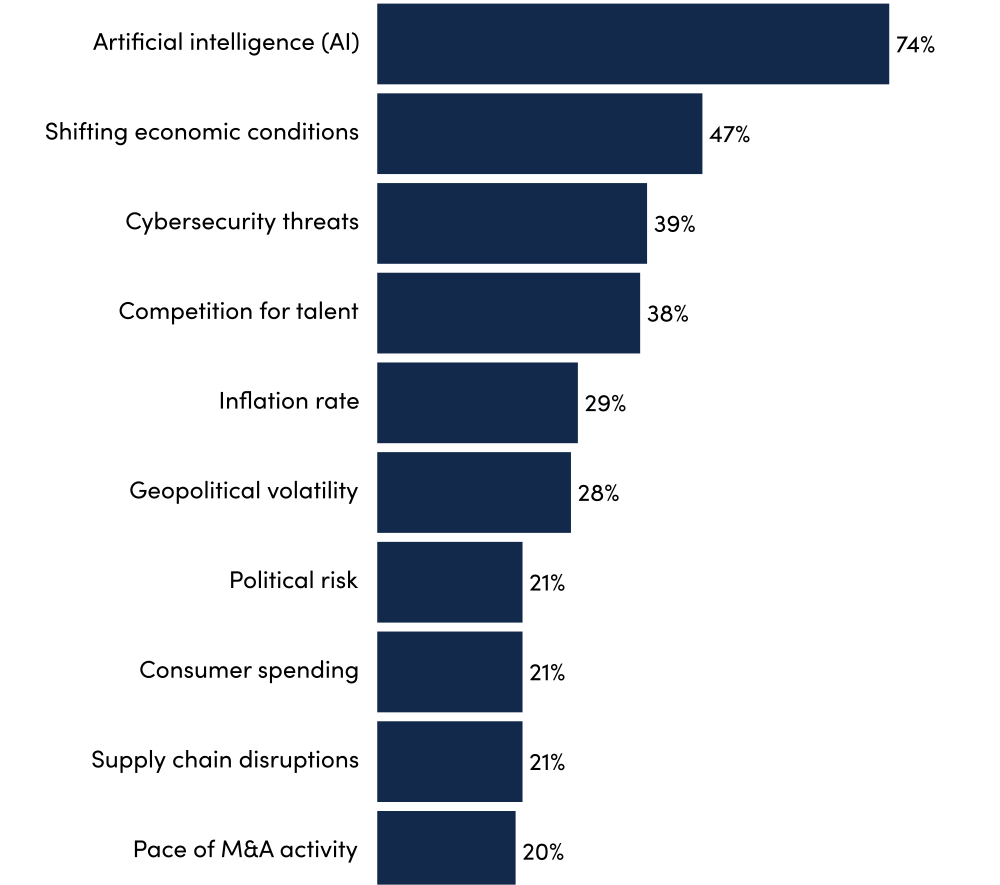
NACD Quarterly Survey Q2 2026, Private company respondents, n=76
AI as a Change Driver
Directors highlighted the transformative and disruptive nature of AI and the importance of identifying the most effective use cases. “Using AI well has not been prioritized and the board is pushing management to do so.” Boards are also trying to understand the business implications while building their own knowledge in a rapidly evolving landscape. Finally, the pace of change creates “uncertainty in workforce planning, capital allocation, and policy response.”
Cybersecurity Risks Are Expanding
“Cyber is now on every agenda” is an indicative statement, with 39 percent of private company boards prioritizing the issue, which has been a top-five concern for the past year. As cyber breaches continued to affect US business, directors highlighted AI as a risk multiplier. One director describes the “increasing convergence between cybersecurity threats, AI capabilities, and geopolitical tensions … raising systemic risk across critical infrastructure, corporate data, and national security frameworks.” Directors are also tracking evolving cybersecurity regulation at the federal and state levels, as well as the effects of the Trump administration’s Executive Order 14409, which is intended to promote advanced AI and cybersecurity.
Uncertain Economic Outlook
Uncertainty is a key director sentiment, with nearly half (47%) of respondents selecting shifting economic conditions as a priority for Q3. Respondents describe the economy as “shifting,” “volatile,” and “by some measures doing well, but it feels shaky.” Directors point to the lingering effects of the Iran war and its impacts on food and fuel prices, high interest rates, and disruption that spanned industries.
Directors’ concerns about inflation increased relative to other topics; 29 percent describe it as a top concern with impacts on consumers, return on investment, and supply chains noted as particularly problematic. In May 2026, the Federal Reserve reported price increases of 4.1% from a year ago, considerably higher than the Fed’s target.
Supply Chain Disruption Remains in Focus
Private boards pointed to complex global supply chains and their vulnerability to disruptions, including war and competition for “key elements in the energy supply chain, such as transformers, gas turbines, switchgear.” The shortage of these key elements can be traced, at least in part, to the boom in data center building. Underlining the uncertainty such shortages can cause, one respondent noted that “supply chain disruptions wreak havoc on both material and more importantly labor planning.”
Geoplotical Volatility
Geopolitical volatility fell in the rankings compared to other issues. However, 28 percent of private company respondents picked geopolitics as a top issue, pointing to war, political risk, and tariffs as contributors to volatility. Directors spoke to the value of stability to enable strategic “focus on the global economy and not just the AI race in the US.”
Top Business issues by Respondent Company Type
| Issue | Overall | Public | Private |
| Artificial intelligence (AI) | 67.77% | 65.15% | 73.68% |
| Shifting economic conditions | 50.00% | 51.52% | 47.37% |
| Cybersecurity threats | 42.15% | 43.18% | 39.47% |
| Geopolitical volatility | 31.82% | 37.88% | 27.63% |
| Competition for talent | 26.03% | 20.45% | 38.16% |
| Regulatory requirements | 23.97% | 26.52% | 17.11% |
| inflation rate | 22.31% | 20.45% | 28.95% |
| Supply chain disruptions | 21.49% | 22.73% | 21.05% |
| Consumer spending | 21.07% | 20.45% | 21.05% |
| Technological change (apart from AI) | 20.25% | 21.97% | 17.11% |
| Political risk | 19.83% | 16.67% | 21.05% |
| Pace of M&A activity | 16.94% | 13.64% | 19.74% |
NACD Quarterly Survey - Q2 2026
Explore data from public company respondents to this survey here.